Nuclear Chain Reactions
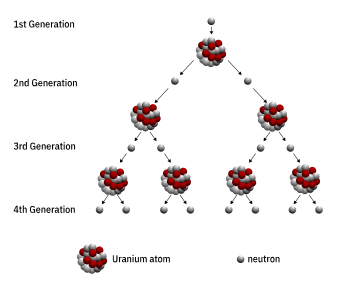
A chain reaction refers to a process in which neutrons released in fission produce an additional fission in at least one further nucleus. This nucleus in turn produces neutrons, and the process repeats. The process may be controlled (nuclear power) or uncontrolled (nuclear weapons).
If each neutron releases two more neutrons, then the number of fissions doubles each generation. In that case, in 10 generations there are 1,024 fissions and in 80 generations about 6 × 10 23 (a mole) fissions.
Energy Released From Each Fission
| Kinetic energy of fission products | 165 MeV |
| Gamma rays | 7 MeV |
| Kinetic energy of the neutrons | 6 MeV |
| Energy from fission products | MeV |
| Gamma rays from fission products | 6 MeV |
| Anti-neutrinos from fission products | 9 MeV |
| 200 MeV |